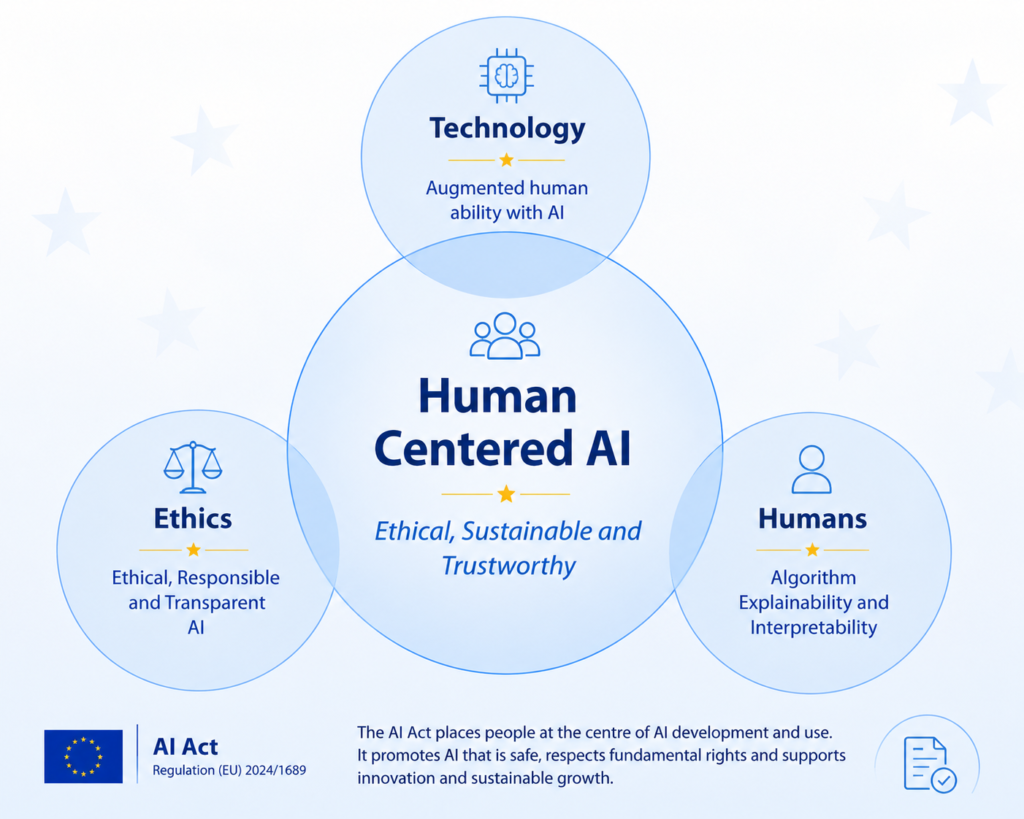
Artificial intelligence has moved from science fiction to smartphones in just a few years. But while millions of young people use AI every day, many educators and youth workers are still trying to understand what responsible use actually looks like. The European Union has recognised this challenge through the AI Act, the world’s first comprehensive legal framework for artificial intelligence. Its goal is simple but ambitious: to encourage innovation while ensuring AI remains human-centred, trustworthy and respectful of fundamental rights.
The Act is designed to:
“Promote the uptake of human centric and trustworthy artificial intelligence (AI) while ensuring a high level of protection of health, safety, fundamental rights as enshrined in the Charter of Fundamental Rights of the European Union, including democracy, the rule of law and environmental protection, to protect against the harmful effects of AI systems in the Union, and to support innovation” (European Parliament & Council of the European Union, 2024).
In the year 2025, AI technologies are increasingly shaping, reshaping and questioning whole societal structures, from education to employment, from community to democracy. Against this backdrop, it is crucial that youth workers are at the forefront of these changes, guiding young people to critically engage with such powerful tools. More than ever, educators of all kinds need to act as proactive agents and guides in this transformation, equipped with the resources and knowledge to foster meaningful discussions about AI’s role in society.
This challenge is compounded by the way AI is understood in broader culture. Artificial intelligence as a concept can trace its origins back to the androids of popular culture and the golem of folklore. In its current incarnation, however, it is at the same time seen as the saviour of humanity and a great threat to its existence and the public debate around it leaves little room for nuance. Technological complexities and the various techno-phobias and -philias of those shaping public opinion make objective analysis increasingly difficult. Thus, the need for tools and voices to provide guidance has become evident, something reflected in the sheer volume of reports and commentary on the uses and implications of AI, published on a near-daily basis.
Within this context, the AI Act of the European Union stands out as the first attempt to regulate the development and use of AI technologies by a political body of real significance. It already serves both as a landmark to orient oneself by and as a lightning rod for those of differing opinion, highlighting the tensions inherent in building consensus around such transformative technologies.
For the past thirty years, internet technologies have driven and changed the evolution of youth and social work, just as they have reshaped nearly every area of society and community. This history has created several generations of young people and youth workers who have shared, though sometimes conflicting, learning paths. Now, as young people are increasingly digitally, and indeed AI, native, one question becomes ever more pressing: What guidance can youth workers provide when the technological developments have become this fast and all encompassing, and how can they help young people use these technologies responsibly?
Welcome to the AI.Proof project, where we try to answer at least some of those questions, do our best to listen as much as we talk, and create a shared learning space for all.